
The demand for quality bra cups continues to create opportunities for lingerie manufacturers, garment factories, fashion brands and wholesale buyers. From everyday bras to saree blouses, sportswear and designer tops, bra cups are essential components that help create the desired garment shape, coverage and finish.
However, buying wholesale bra cups requires more than comparing prices. Businesses must consider cup shape, material, thickness, dimensions, quality consistency, minimum order quantity (MOQ) and supplier reliability before placing a bulk order.
Choosing the wrong product can lead to fitting problems, wasted materials, production delays and additional costs. Selecting the right bra cup from the beginning helps manufacturers streamline product development and maintain consistent garment quality.
In this guide, we explain how to select wholesale bra cups, what to check before ordering and how to choose a suitable supplier for your business.
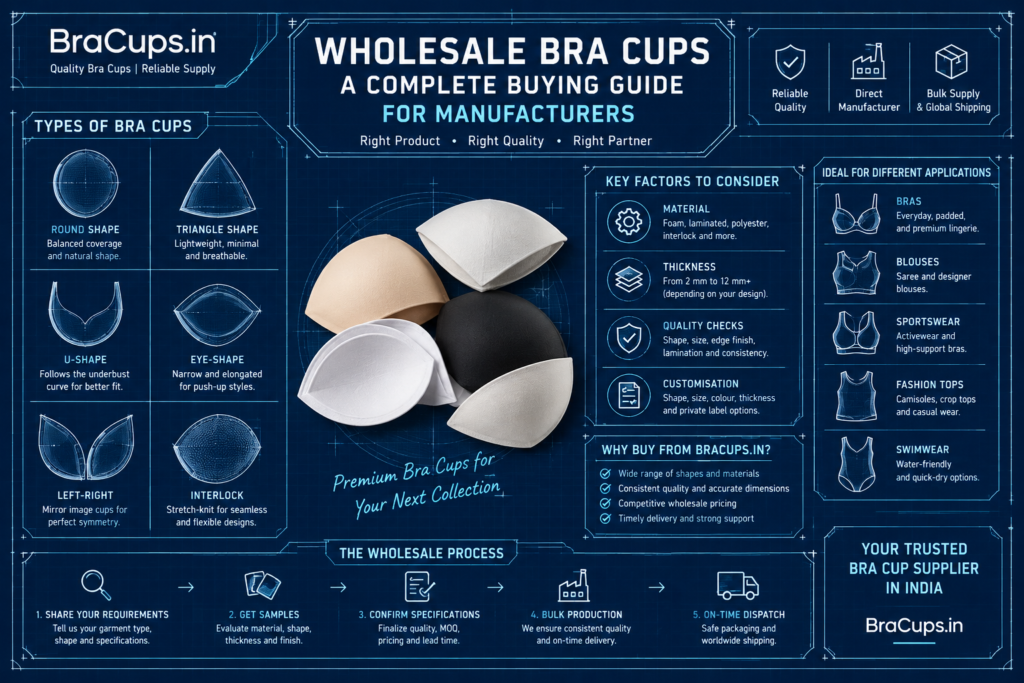
What Are Wholesale Bra Cups?
Wholesale bra cups are bra cup components purchased in larger quantities for garment manufacturing, resale or commercial production. They are used in bras and a wide range of other garments that require bust coverage, shaping or additional structure.
Unlike individual retail purchases, wholesale sourcing is intended for businesses that need repeatable specifications and quantities suitable for their production requirements.
Wholesale bra cups are commonly used by:
- Lingerie manufacturers
- Bra manufacturing companies
- Saree blouse manufacturers
- Fashion garment factories
- Private-label lingerie brands
- Apparel wholesalers and distributors
- Sportswear and activewear manufacturers
Buying in bulk can help businesses organise their production requirements, but the final value depends on the quality of the product, the agreed specifications and the supplier’s ability to meet the order requirements.
Why Choosing the Right Bra Cup Supplier Matters
A reliable bra cup supplier can help a garment business maintain consistency across different styles and production batches.
Cup dimensions, thickness, shape and material affect how the component fits inside a garment. Even small differences may become noticeable when the finished product uses lightweight fabric or a close-fitting design.
Before selecting a wholesale supplier, consider the following factors.
Product Variety
A supplier with a suitable range of cup shapes and materials makes it easier to develop different garment styles.
Check whether the supplier offers the specific shapes, sizes and constructions required for your collection.
Consistent Product Specifications
Products supplied in repeat orders should match the approved specifications as closely as possible.
Ask about dimensional tolerances, thickness measurements, material composition and quality inspection procedures.
Clear Pricing and MOQ
The minimum order quantity and pricing structure should be understood before you commit to an order.
Confirm whether the MOQ applies per shape, size, colour or complete purchase order.
Sampling and Communication
Samples allow you to evaluate the product before committing to bulk production.
Clear communication about specifications, production timelines and delivery arrangements also helps reduce misunderstandings.
Different Types of Bra Cups Available for Wholesale
The correct bra cup depends on the garment design, desired silhouette and construction method. Below are several shapes that manufacturers may consider.
1. Round Shape Bra Cups
Round shape bra cups are suitable for many designs requiring a rounded, balanced profile.
Potential applications include padded bras, everyday lingerie and selected fashion garments.
When sourcing round cups, compare the width, depth, height and thickness with your garment pattern.
2. Triangle Shape Bra Cups
Triangle cups have a triangular outline and are often considered for bralettes, lightweight lingerie and selected crop-top designs.
They may suit garments with a more minimal appearance, depending on their dimensions and construction.
3. U-Shape Bra Cups
U-shape cups have a curved profile that may work with particular structured bra patterns.
Check the lower-cup contour and its compatibility with the garment construction before approving a sample.
4. Eye-Shape Bra Cups
Eye-shape cups have a specialised outline used in selected lingerie designs.
Their suitability depends on the intended garment silhouette, cup orientation and pattern requirements.
5. Left-Right Bra Cups
Left-right cups are designed as corresponding components for the two sides of a garment.
Confirm that the supplied pieces have the correct orientation and are suitable for your pattern.
6. Interlock Bra Cups
Interlock cups use a knitted construction and may be considered for selected flexible or lightweight garment applications.
Evaluate their stretch, recovery, thickness and finished appearance before choosing them for your product line.
Always confirm current product availability and specifications directly with your supplier.
How to Choose the Right Material for Wholesale Bra Cups
Material selection influences the feel, structure and performance of a bra cup. Different materials may suit different garment categories.
Foam Bra Cups
Foam cups are commonly used in padded and structured designs. Their performance depends on the foam formulation, density, thickness and manufacturing process.
They may be suitable for products that require a defined silhouette.
Laminated Bra Cups
Laminated cups combine layers of materials to achieve a particular finish or construction.
When buying laminated cups, check bonding quality, surface consistency and compatibility with the outer fabric.
Polyester Bra Cups
Polyester-based constructions are available in different forms and specifications. Their suitability depends on their firmness, thickness, flexibility and intended application.
Interlock Bra Cups
Interlock constructions can provide a more flexible alternative to certain structured cups.
Check stretch and recovery carefully, particularly when the finished garment needs to maintain its shape through repeated wear.
Buying tip: Never select a bra cup based only on the material name. Evaluate the actual sample and its performance inside the garment.
How to Select the Correct Bra Cup Thickness
Cup thickness affects garment bulk, silhouette and the space required inside the garment pattern.
Thinner cups may be suitable for selected lightweight or low-profile garments. Medium-thickness cups may work for some everyday padded designs, while thicker cups can be considered for styles that require additional projection.
These are general design considerations, not universal thickness rules.
Before ordering, ask your supplier to clarify:
- Nominal cup thickness
- Thickness at the centre and edges, where applicable
- Measurement method
- Dimensional tolerances
- Available thickness options
Testing the cup inside the intended garment is essential because the outer fabric, lining and stitching can change the final appearance.
Wholesale Bra Cups for Different Garment Industries
Bra and Lingerie Manufacturing
Lingerie manufacturers need cups that fit the intended bra pattern and provide the required coverage and silhouette.
Check the cup’s dimensions, symmetry, edge finish and consistency across the selected size range.
Saree Blouse Manufacturing
Blouse manufacturers must consider neckline depth, garment lining, fabric weight and the available space within the pattern.
A suitable cup should integrate with the blouse construction without creating unwanted edges or altering the intended appearance.
Sportswear and Activewear
Sportswear requires careful consideration of flexibility, recovery, moisture exposure and movement.
The cup should be evaluated as part of the completed garment. Support depends on the full construction, including the fabric, band, straps and overall fit.
Fashion Tops and Dresses
Camisoles, crop tops and dresses may require cups that provide discreet coverage while working with the garment’s neckline and fabric.
Check whether the selected cup remains concealed during normal movement and whether its shape matches the design.
Quality Checklist Before Placing a Bulk Order
One of the most important steps in wholesale sourcing is inspecting samples before approving production.
Check Dimensions
Measure the cup against the agreed specification sheet. Verify the width, height, depth and other relevant dimensions.
Inspect Surface Quality
Look for visible defects, uneven finishing, damage and inconsistencies in the material.
Check Symmetry and Shape
Compare corresponding cups to confirm that their shape and orientation meet the requirements of the design.
Examine Lamination and Edges
For laminated products, inspect the bonded layers. For all applicable cup types, check that the edges are suitable for the intended sewing or attachment process.
Test the Finished Garment
Fit the cup into the actual garment pattern and inspect the coverage, neckline, symmetry and external appearance.
Confirm Repeat-Order Consistency
Keep an approved reference sample and written specifications for future orders. Agree on how the supplier will inspect and document bulk production quality.
Understanding MOQ When Buying Wholesale Bra Cups
MOQ stands for minimum order quantity. It represents the minimum quantity a supplier accepts for a particular product or order specification.
Different products may have different MOQs depending on their construction, size, customisation requirements and production process.
Before placing an order, ask your supplier:
- What is the minimum quantity per style?
- Does the MOQ vary by size or material?
- Are mixed shapes permitted in one order?
- Are samples available before bulk ordering?
- Is there an additional charge for customised specifications?
- What are the expected production and dispatch timelines?
Do not assume that one supplier’s MOQ applies to every product. Confirm the current terms for your exact requirements.
How to Calculate the Cost of a Wholesale Bra Cup Order
Comparing unit prices is useful, but businesses should also consider the complete cost of sourcing.
For example, a bulk order may involve:
- Product cost
- Sampling and development expenses
- Packaging and transportation
- Quality inspection
- Potential wastage or rejected components
- Storage and inventory expenses
Request a written quotation that explains the product specifications, quantity, applicable charges and delivery terms.
The objective is to understand the total purchasing cost while maintaining the quality required for your finished garments.
Why Consider BraCups.in for Wholesale Bra Cups?
BraCups.in is the website associated with Shri Maha Dev Enterprises, which serves businesses looking for bra cup products.
For lingerie brands, garment manufacturers and wholesale buyers, the appropriate next step is to identify the required cup shape, material, thickness and quantity.
Before confirming an order, contact the supplier to discuss product availability, samples, MOQ, specifications and delivery arrangements.
Explore the product range at BraCups.in.
If you are developing a new collection, prepare your garment requirements before contacting the supplier. Sharing measurements, reference images and intended applications can make product discussions more efficient.
Steps to Place a Wholesale Bra Cup Order
A structured sourcing process helps avoid unnecessary delays.
Step 1: Define your requirements. Identify the garment category, cup shape, size range, material and required quantity.
Step 2: Shortlist suitable products. Compare available options against your garment pattern and design requirements.
Step 3: Request samples. Evaluate dimensions, finish, material and fit.
Step 4: Confirm the quotation. Review unit price, MOQ, lead time and delivery terms.
Step 5: Approve the specification. Confirm the reference sample and quality requirements in writing.
Step 6: Place the bulk order. Follow the agreed production schedule and inspection process.
Step 7: Inspect the delivery. Check the received goods against the approved specification and purchase order.
Frequently Asked Questions
Where can I buy wholesale bra cups in India?
You can explore specialist suppliers such as BraCups.in and compare their product range, specifications, MOQ, sample options and delivery terms before placing an order.
Which bra cup shapes are available for wholesale purchase?
Common shapes include round, triangle, U-shape, eye-shape and left-right cups, as well as interlock constructions. Availability varies by supplier.
Can I buy bra cups for saree blouse manufacturing?
Yes. Select cups according to the blouse pattern, neckline, coverage requirements and fabric construction. Always test a sample inside the actual blouse.
What is the minimum order quantity for wholesale bra cups?
MOQ varies by supplier and product. Ask for the current minimum quantity for your selected shape, size, material and specification.
Should I request samples before ordering in bulk?
Yes. Samples help you assess dimensions, material, finish and compatibility with the garment before committing to a large order.
How do I choose between foam and interlock bra cups?
Foam cups may be appropriate for designs requiring more defined structure, while interlock constructions may suit selected flexible styles. The right choice depends on the actual product and garment requirements.
How can I maintain consistent quality in repeat orders?
Keep an approved reference sample, document the specifications and agree on inspection criteria with the supplier. Check representative samples from each delivery.
Conclusion
Buying wholesale bra cups is an important sourcing decision for lingerie brands, garment factories and apparel businesses. The right choice depends on the cup shape, material, thickness, dimensions and intended garment application.
Before committing to bulk production, request samples, check specifications, test the cup inside the garment and confirm the supplier’s MOQ and delivery terms.
BraCups.in can be a starting point for businesses exploring bra cup products. Contact the supplier to discuss your requirements and verify current product availability.
Looking for wholesale bra cups for your next collection? Visit BraCups.in to explore the product range and enquire about suitable options.