
Choosing the right bra cup material is an important decision for lingerie manufacturers, garment factories and fashion brands. The material influences the cup’s structure, surface finish, flexibility and appearance inside the finished garment.
Two options that manufacturers often compare are foam bra cups and fabric-based bra cups. Foam cups are commonly considered for products requiring a more defined shape, while fabric-based constructions may suit designs where flexibility, softness or a textile surface is preferred. However, performance depends on the actual material, thickness and construction rather than the material name alone.
For businesses manufacturing bras, saree blouses, camisoles, sportswear and fashion tops, selecting the right cup can help reduce fitting problems and improve product consistency.
In this guide, we compare foam bra cups and fabric bra cups, explain their main differences, explore their applications and share practical tips for choosing the right option for your garment collection.
What Are Foam Bra Cups?
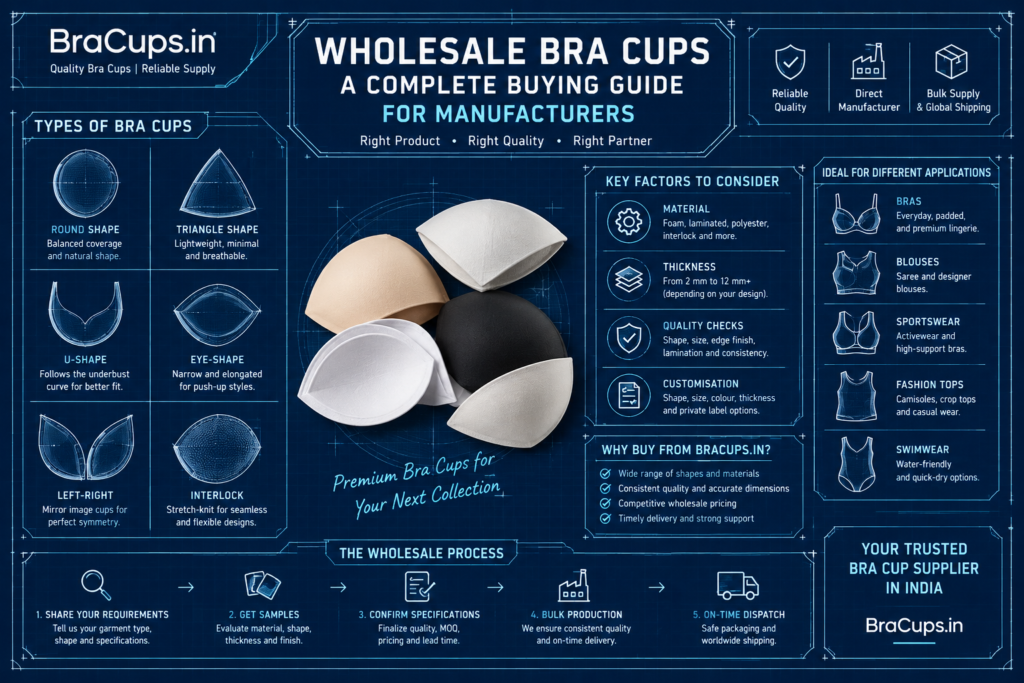
Foam bra cups are shaped components made using foam materials. Depending on their construction, they may provide a defined profile, coverage and additional structure to a garment.
Foam cups are available in different shapes, thicknesses and specifications. Some are moulded into a three-dimensional form, while others use different foam constructions and surface finishes.
Common applications include:
- Padded bras and everyday lingerie
- T-shirt bras and selected seamless designs
- Saree blouses and designer blouses
- Fashion tops and dresses
- Selected swimwear and other structured garments
The correct foam cup depends on the garment pattern and the intended result. A lightweight cup may suit a low-profile design, while a thicker cup may be selected when additional shaping is needed.
Advantages of Foam Bra Cups
1. Defined shape
A pre-shaped foam cup can help a garment maintain a particular silhouette. This is useful when the design depends on a consistent cup profile.
2. Different thickness options
Depending on the supplier’s range, foam cups may be available in multiple thicknesses. Manufacturers can compare these options according to the coverage and profile required.
3. Smooth surface possibilities
Foam cups with appropriate moulding or lamination may help create a smooth appearance under close-fitting clothing. The final result depends on edge construction, outer fabric and garment design.
4. Versatility
Foam cups can be incorporated into many product categories, provided that the specific construction is suitable for the intended application.
Things to Check Before Buying Foam Cups
Foam cups are not all identical. Differences in density, thickness, flexibility and construction can affect their performance.
Before purchasing, inspect the dimensions, surface finish, edge quality and shape recovery. Check whether the chosen cup remains compatible with the outer fabric after stitching and washing.
Do not assume that every foam cup is suitable for sportswear or swimwear. These applications require testing for their specific use conditions.
What Are Fabric Bra Cups?
The term fabric bra cups can refer to cups made using textile-based constructions, fabric-covered cup components or fabric and foam combinations. These are not necessarily the same product, so buyers should clarify the construction with the supplier.
Fabric-based cups may be considered for garments where flexibility, a textile surface or a particular feel is important.
Potential applications include:
- Selected soft-cup bras
- Bralettes and lightweight lingerie
- Camisoles and crop tops
- Selected activewear designs
- Garments requiring a textile-covered cup surface
Interlock cups are one example of a textile-based construction available in the wider bra cup market. Their properties depend on the knit structure, material composition and manufacturing specification.
Advantages of Fabric-Based Bra Cups
1. Flexible construction options
Some fabric-based cups move more readily with the garment than firmer foam constructions. The amount of flexibility depends on the fabric and how the cup is made.
2. Textile surface
Fabric-based or fabric-covered cups can offer a surface that works well with particular garment constructions and design preferences.
3. Different stretch characteristics
Knitted materials may stretch and recover according to their construction. This can be useful in garments designed around flexibility.
4. Design variety
Fabric-based cups and fabric-covered components can be developed for different looks, textures and garment applications.
Things to Check Before Buying Fabric Cups
Fabric cups should be assessed for stretch, recovery, thickness, stitching compatibility and shape stability.
A soft cup may not provide the same defined profile as a structured foam cup. Conversely, a firmer fabric-covered cup may incorporate foam or other layers that significantly change its performance.
Ask the supplier exactly what the cup contains and how it is constructed before comparing prices or specifications.
Foam Bra Cups vs Fabric Bra Cups: Key Differences
The main differences depend on the specific products being compared. The following table provides a starting point for manufacturers.
| Factor | Foam bra cups | Fabric-based bra cups |
|---|---|---|
| Structure | Often suited to defined, pre-shaped profiles | Can range from flexible to structured |
| Surface | Foam surface or an added laminate or covering | Textile surface or fabric-covered construction |
| Flexibility | Depends on foam type, thickness and construction | Depends on fabric, knit structure and any added layers |
| Shape retention | Depends on foam quality and design | Depends on fabric recovery and overall construction |
| Thickness | Available in different thickness profiles | Varies according to the textile and construction |
| Garment use | Padded bras and selected structured garments | Soft-cup styles and selected flexible garments |
| Main checks | Thickness, recovery, shape and edge finish | Stretch, recovery, seams, finish and shape stability |
This comparison is general. A fabric-covered foam cup may combine characteristics of both categories. Compare actual samples instead of treating the two groups as completely separate.
Which Bra Cup Material Is Better for Different Garments?
There is no universally better option. The right choice depends on what the garment needs to achieve.
1. Everyday Bras
Everyday bras may require a balance between coverage, comfort, shape and repeatable sizing.
Foam cups may be appropriate when the design requires a defined silhouette or padded construction. Fabric-based cups can be considered for softer designs where their structure provides the intended fit.
Test the finished bra for cup symmetry, coverage, edge visibility and comfort.
2. T-Shirt Bras
T-shirt bras are often designed to produce a smooth appearance under fitted clothing.
A suitably moulded foam cup with a compatible surface finish may work well for this purpose. However, the finished result also depends on the outer fabric, edge thickness and cup dimensions.
For any proposed material, check the garment under different lighting conditions and against the fabrics the brand intends to use.
3. Saree Blouses
Saree blouses may involve deep necklines, fitted panels, decorative fabrics and different lining constructions.
Foam cups can be considered for designs requiring a defined profile, while fabric-based constructions may suit other styles.
The most important step is to fit the cup inside the actual blouse pattern. Verify neckline coverage, cup position, stitching compatibility and the appearance beneath the finished fabric.
For bridal and designer blouses, approve a complete sample before bulk production.
4. Sports Bras and Activewear
Activewear requires careful attention to flexibility, movement, moisture exposure and recovery.
A flexible fabric-based cup may suit certain designs, while other sports bras may use a structured or foam-based component.
The cup alone does not determine support. Support also depends on the garment’s band, straps, fabric compression and overall construction.
Test the complete garment through appropriate movement, wash and recovery assessments before selecting a component for production.
5. Camisoles and Crop Tops
Camisoles and crop tops can require lightweight components that integrate comfortably with the garment.
The choice between foam and fabric-based cups depends on the intended coverage, outer fabric, garment fit and desired silhouette.
Consider whether the cup will remain in position and whether its edges will be visible through the shell.
6. Swimwear
For swimwear, the selected cup and its construction must suit exposure to water, washing and drying.
Do not assume that either foam or fabric-based cups are suitable for swimwear simply because they work in lingerie. Confirm the material specification and conduct appropriate tests for the intended use.
How to Choose the Right Bra Cup for Your Brand
For manufacturers, a clear selection process helps connect material choice with the garment’s technical requirements.
Step 1: Identify the Product Category
Determine whether you are making an everyday bra, designer blouse, sports bra, camisole, dress or another garment.
Step 2: Define the Required Shape
Choose the cup profile according to the pattern, neckline and desired silhouette.
Step 3: Compare Material Options
Request details about foam type, fabric composition, lamination and other construction features. Clarify whether a fabric cup includes a foam layer.
Step 4: Check Thickness and Dimensions
Compare cup width, height, depth and thickness against the garment pattern. Ask how thickness is measured, especially when edges taper.
Step 5: Test a Physical Sample
Use the intended outer fabric, lining, seams and attachment method. Check the complete garment rather than assessing the loose cup alone.
Step 6: Review Performance
Where relevant, examine shape retention, wash stability, flexibility and surface appearance.
Step 7: Approve the Final Specification
Document the approved sample and the agreed product specifications before placing a bulk order.
Common Mistakes When Choosing Bra Cup Materials
Selecting by Price Alone
A lower unit price does not always deliver better overall value. Material mismatch, rework, rejected products and production delays can increase the total cost.
Ignoring the Outer Fabric
A cup that looks suitable on its own may create visible edges or unwanted bulk after it is inserted into the garment.
Assuming All Foam Cups Perform the Same Way
Foam properties vary. Thickness, density, construction and surface finish all influence performance.
Treating Every Fabric Cup as Non-Padded
A textile surface does not necessarily mean that a cup contains no foam. Confirm the actual construction.
Skipping the Sample Stage
Approving a bulk order without testing a physical sample increases the risk of discovering problems after production has started.
Wholesale Foam and Fabric Bra Cups: What Buyers Should Ask
Before contacting a bra cup supplier, prepare a short specification brief covering the garment type, required cup shape, size range, thickness, material preference and expected order quantity.
Ask the supplier these questions:
- Which foam and fabric-based cup options are currently available?
- Are the cups fabric-only, foam-based or fabric-covered foam?
- What thickness and size options are offered?
- Can physical samples be supplied for evaluation?
- What is the minimum order quantity for the exact product?
- Are custom specifications available?
- What are the production and dispatch timelines?
- How is quality checked across a bulk order?
These questions help you compare suppliers using the same requirements rather than comparing products with different specifications.
Why Explore BraCups.in?
BraCups.in is the online presence of Shri Mahadev Enterprises, a Delhi-based bra cup manufacturer and supplier. Its published product range includes foam, polyester, interlock and laminated bra cup options, alongside different cup shapes and specifications.
For businesses comparing foam and fabric-based constructions, the next step is to check which products match the intended garment.
Visit BraCups.in to explore the product range. You can also review the About Us page and contact the team to enquire about current material options, product specifications, sample availability and wholesale requirements.
Availability, MOQ and customisation should be confirmed directly for the product you intend to purchase.
Frequently Asked Questions
Are foam bra cups better than fabric bra cups?
Neither is automatically better. Foam cups may suit designs requiring a more defined shape, while some fabric-based constructions may suit flexible styles. The correct option depends on the garment pattern and the specific cup construction.
Are fabric bra cups always non-padded?
No. Fabric-covered cups may include foam or additional layers. Ask the supplier to confirm the complete material composition.
Which bra cups are suitable for saree blouses?
The right option depends on the neckline, blouse pattern, fabric and desired silhouette. Test the cup in a complete blouse sample before approving production.
Can foam bra cups be used in sports bras?
Some foam cups may be appropriate for certain sports bra designs. Suitability depends on the foam specification and the complete garment’s requirements for movement, moisture exposure and support.
What should manufacturers check before buying wholesale bra cups?
Check the material, shape, dimensions, thickness, edge finish, sample performance, MOQ, quality criteria and delivery terms before confirming the order.
Can I request samples from a bra cup supplier?
Contact the supplier to confirm whether samples are available for the selected product. Sampling is a useful way to assess compatibility with your garment before committing to bulk production.
How do I choose a supplier for foam or fabric bra cups?
Compare the supplier’s relevant product range, specifications, sample process, communication, quality standards and commercial terms. Confirm that the supplier can meet your particular requirements before placing an order.
Conclusion
Foam bra cups and fabric-based bra cups can both be useful in garment manufacturing, but their performance depends on their individual construction and intended application.
Foam cups may be suited to designs requiring a defined profile, while fabric-based constructions can offer different surface and flexibility characteristics. The right choice should always be guided by the garment pattern, outer fabric, desired shape and expected use.
For lingerie brands, garment manufacturers and wholesalers, the most practical approach is to compare specifications, test physical samples and approve the finished garment before moving into bulk production.
Explore the options at BraCups.in and enquire about the materials and cup shapes suitable for your next collection.