
Introduction
Choosing the right bra cups is an important step in developing comfortable, attractive and well-fitted garments. For lingerie manufacturers, fashion brands, blouse manufacturers and apparel businesses, the right cup can influence the final silhouette, garment construction, production consistency and customer satisfaction.
However, not every bra cup is suitable for every garment. A cup designed for an everyday padded bra may not perform in the same way when used in a saree blouse, sports bra, camisole or swimwear design. Differences in cup shape, thickness, material and construction can affect how the finished garment fits and looks.
This is why manufacturers should evaluate bra cups before finalising their garment patterns and moving into bulk production.
Whether you are launching a new lingerie collection or sourcing components for an established clothing business, understanding the available bra cup options can help you make better purchasing decisions.
In this guide, we explain the different bra cup shapes, commonly used materials, garment applications, quality checks and important considerations for wholesale sourcing. We also explain how businesses can work with a bra cup manufacturer such as BraCups.in to explore suitable options for their production requirements.
What Are Bra Cups?
Bra cups are shaped components incorporated into bras and other garments to provide coverage, structure and a defined silhouette. Depending on their construction, they may be made from foam, polyester-based materials, interlock fabric or laminated materials.
Bra cups are used in a wide variety of products, including:
- Everyday bras and padded bras
- Saree blouses and designer blouses
- Bralettes and crop tops
- Sports bras and activewear
- Camisoles and fashion tops
- Dresses and selected swimwear designs
- Other garments requiring internal bust shaping
The ideal bra cup depends on the garment pattern, the required level of structure, the outer fabric and the intended customer.
For manufacturers, the objective is not simply to select an attractive cup. It is to find a component that works with the entire garment design.
1. Different Types of Bra Cups for Garment Manufacturing
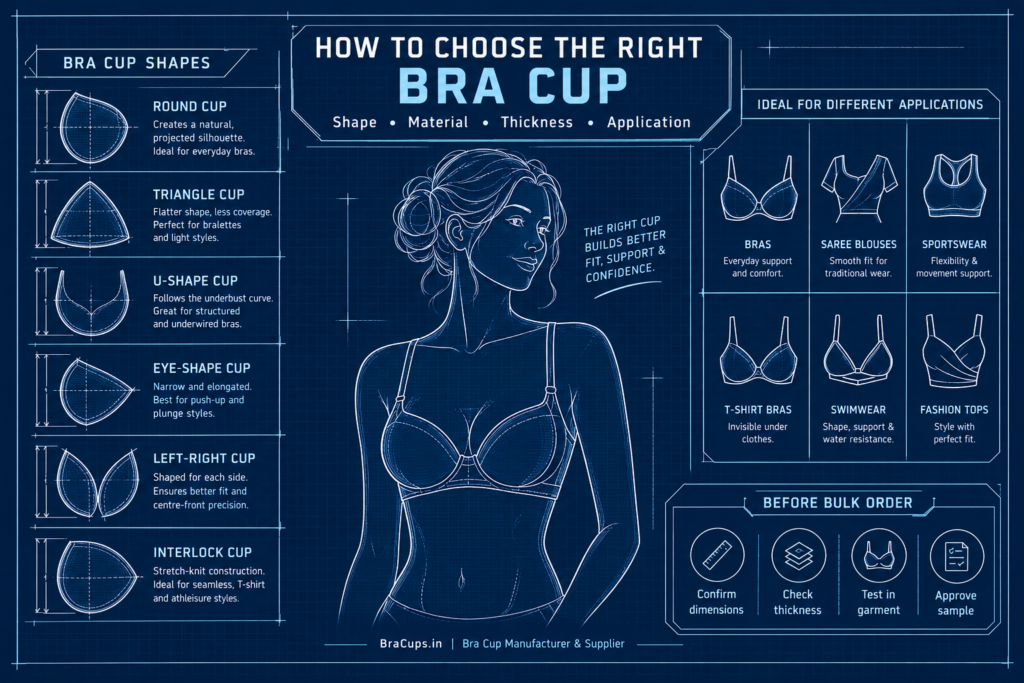
Bra cups are available in different shapes to suit different construction requirements. Understanding their characteristics helps manufacturers shortlist suitable products before requesting samples.
Round Shape Bra Cups
Round bra cups are a versatile option for garments requiring a balanced, rounded silhouette. Depending on the material and dimensions, they can be incorporated into everyday lingerie, padded bras and selected fashion garments.
They may be suitable for:
- Everyday padded bras
- Basic lingerie collections
- Selected blouse designs
- Fashion tops requiring a rounded profile
When choosing round cups, compare their width, height, depth and thickness with the garment pattern. A cup that appears suitable on its own may fit differently once enclosed within the outer fabric.
Triangle Shape Bra Cups
Triangle bra cups feature a triangular outline and are commonly considered for designs with a lighter, more minimal appearance.
Potential applications include bralettes, selected fashion lingerie, crop tops and garments with triangular cup construction.
The important consideration is neckline compatibility. The cup must fit within the intended garment shape without creating unwanted edges or reducing the required coverage.
U-Shape Bra Cups
U-shape cups have a curved profile that may suit particular structured bra and fashion garment designs.
They can be considered when developing products that require a specific lower-cup contour or a particular relationship between the cup and the garment pattern.
Before placing an order, manufacturers should check the cup profile, dimensions and compatibility with the intended construction.
Eye-Shape Bra Cups
Eye-shape bra cups have a specialised outline suited to particular lingerie designs. Their usefulness depends on the desired silhouette and how the cup will be positioned within the garment.
They may be considered for selected fashion bras, specialised cup constructions and custom garment projects.
Because specialised shapes can be sensitive to pattern differences, physical sampling is especially important before approving production.
Left-Right Bra Cups
Left-right bra cups are designed as corresponding cups for the two sides of a garment. Correct orientation and matching dimensions are important when a design uses separate left and right components.
Manufacturers should confirm whether the product is supplied as a left-right pair and whether the orientation matches their pattern.
This check helps prevent assembly mistakes during sampling and production.
Interlock Bra Cups
Interlock bra cups use a knitted construction that may provide flexibility and a different surface character from conventional moulded foam cups.
They can be considered for selected soft-cup, lightweight and stretch-oriented garments, depending on the actual product specification.
Manufacturers should evaluate the cup’s stretch, recovery, thickness and finished appearance to determine whether it suits the garment.
2. How to Choose the Right Bra Cups for Different Garments
The same cup cannot be expected to deliver identical results across every garment category. Each application has different design priorities.
Bra Cups for Everyday Bras
Everyday bras typically require a balance of comfort, coverage, shape and repeatable sizing.
Round or other suitable structured cups may work well, depending on the bra’s construction. Foam and laminated options can be considered when the design requires a defined silhouette.
Before selecting a cup, check how it fits the pattern, whether its edges remain concealed and whether the finished garment maintains the intended shape.
Bra Cups for Saree Blouses
Saree blouses often feature fitted panels, decorative fabrics, deep necklines and different sleeve constructions. The cup must fit within the available pattern space without disturbing the external appearance.
When selecting bra cups for blouses, consider:
- Blouse neckline and depth
- Cup width, height and depth
- Outer fabric thickness
- Required coverage
- Stitching and attachment method
- Desired silhouette
- Garment fitting and alteration requirements
For bridal and designer blouses, sample the cup inside the actual garment. Testing only the loose cup cannot show how it will interact with embroidery, lining, seams and other construction details.
Bra Cups for Sports Bras
Sportswear requires careful consideration of flexibility, movement, moisture exposure and recovery.
The appropriate cup depends on the intended activity, garment structure and required support level. Flexible constructions may be suitable for some designs, while other products may need more structured components.
Do not assume that a particular cup will provide high-impact support on its own. Support also depends on the garment’s band, straps, fabric, compression and overall construction.
Test the completed sports bra through suitable movement and wash tests before approving bulk production.
Bra Cups for T-Shirts and Seamless Garments
T-shirt bras and seamless garments often require a smooth exterior appearance. Cup edges, changes in thickness and inconsistent shaping can become visible through lightweight or close-fitting fabrics.
For these products, consider the cup’s surface finish, thickness profile, dimensional consistency and compatibility with the shell fabric.
Laminated or moulded options may be appropriate for certain designs, while other constructions may be more suitable for different garment requirements.
The final decision should be based on a sample of the complete garment rather than the cup alone.
Bra Cups for Swimwear and Fashion Tops
Swimwear and fashion tops can require different combinations of shape, coverage and flexibility.
For swimwear, verify that the chosen cup and its construction are suitable for the intended exposure to water, washing and drying. Do not assume that all foam or laminated cups are suitable for swimwear.
For fashion tops, consider the neckline, fabric weight, attachment method and whether the cup should remain hidden during normal wear.
3. Understanding Bra Cup Materials
Cup shape determines the general profile, but material influences the component’s feel, flexibility, structure and performance.
Foam Bra Cups
Foam cups are widely used in structured and padded garment designs. Their properties depend on the foam formulation, density, thickness and manufacturing process.
They may be considered when the design requires a defined shape or additional structure.
Manufacturers should check foam uniformity, edge quality, compression recovery and dimensional consistency.
Laminated Bra Cups
Laminated cups combine layers of materials to achieve a particular construction or surface finish.
They may be appropriate for products where the interaction between the cup surface and outer fabric is important.
Before bulk approval, inspect the bonding, surface appearance and resistance to separation under the expected garment-care conditions.
Polyester Bra Cups
Polyester-based cup constructions may be suitable for a range of lingerie and apparel applications, depending on their structure and specification.
Evaluate their firmness, thickness, finish and recovery against the requirements of the garment.
The material name alone is not enough to determine the finished performance of a cup.
Interlock Bra Cups
Interlock constructions can offer different flexibility and surface characteristics from structured foam products.
They may be useful in designs where a more flexible component is preferred. However, stretch and recovery vary by construction, so testing is essential.
4. Why Bra Cup Thickness Matters
Thickness can influence garment bulk, projection, surface smoothness and how easily a cup fits inside the outer shell.
A thinner cup may be suitable for a low-profile design, while a thicker cup may be selected when additional structure or a more pronounced profile is required.
There is no single thickness that works for all garments.
When comparing products, ask the supplier for the actual thickness specification and clarify whether the measurement refers to the centre, edge or another defined point.
Cup thickness should be evaluated alongside its shape and material. Two cups with the same nominal thickness can perform differently because their profiles and material properties differ.
5. How to Check Bra Cup Quality Before Bulk Production
A product sample is a starting point, not a guarantee that every piece in a production batch will be identical.
Before approving an order, establish clear specifications and inspect representative samples.
Check Dimensions and Shape
Record the required width, height, depth and other relevant measurements. Compare the sample with the garment pattern and the approved specification sheet.
Inspect Edge Finishing
Look for uneven edges, visible defects, damage or inconsistencies that could affect stitching and the finished appearance.
Check Material Consistency
Inspect the surface and structure for noticeable variations in density, thickness or finish.
For laminated products, examine the bonded layers for visible separation or defects.
Test the Cup Inside the Garment
Insert or attach the cup using the intended manufacturing method. Check the neckline, coverage, symmetry, seams and exterior appearance.
Conduct Appropriate Wash and Wear Tests
Where applicable, evaluate shape retention, material stability and construction after the garment has undergone its expected care process.
For activewear and swimwear, use tests appropriate to the intended product conditions.
Document the approved sample and agreed specifications so that subsequent production can be checked against the same reference.
6. Wholesale Bra Cup Sourcing: What Buyers Should Know
For lingerie brands, garment factories and wholesalers, sourcing involves more than comparing the price per pair.
A supplier should be able to clarify product availability, specifications, minimum order quantity, lead time and sample arrangements.
Confirm the Minimum Order Quantity
The minimum order quantity, or MOQ, is the smallest order a supplier accepts for a particular product or specification.
BraCups.in lists a minimum order quantity starting from 1,000 pairs on its website. Buyers should confirm the current MOQ for the exact shape, material, size and specification they require.
When comparing suppliers, check whether the MOQ applies per shape, size, colour or complete order.
Request Samples Before Ordering
Samples help you evaluate dimensions, material, finish and compatibility with your pattern.
For new products, compare samples from the shortlisted options using the same garment design. This makes the differences easier to assess.
Confirm Production Lead Time
Ask the supplier to confirm the production schedule, dispatch estimate and any additional time required for custom specifications.
Do not base a launch date solely on a general industry estimate. Build the confirmed schedule into your development plan.
Discuss Customisation Requirements
If standard catalogue products do not meet your requirements, ask whether the supplier can accommodate your preferred shape, material, thickness, size or finishing.
Customisation availability should be confirmed for the specific product rather than assumed across the entire range.
Compare Total Sourcing Cost
The lowest unit price is not always the lowest overall cost.
Consider the component price, transport, sampling, inspection, potential wastage and the cost of correcting a mismatch after production begins.
A properly tested component can help reduce avoidable rework and improve production planning.
7. Why Consider BraCups.in for Wholesale Bra Cups?
BraCups.in is the online business presence of Shri Mahadev Enterprises, a Delhi-based manufacturer and supplier of bra cups and related garment components.
Its published product range includes round shape, triangle shape, U-shape, left-right, eye-shape and interlock bra cups, alongside different material options.
For businesses developing lingerie, blouses and other garments, the next step is to identify the product that matches the garment requirements and request the relevant specifications.
Before placing a wholesale order, discuss:
- Required cup shape and size
- Material and thickness
- Expected quantity and MOQ
- Sample availability
- Customisation requirements
- Production and dispatch timelines
- Quality specifications and acceptable tolerances
Visit the BraCups.in website to explore the range and contact the team for product details.
You can also visit the About Us page to learn more about Shri Mahadev Enterprises.
8. A Practical Checklist Before Placing Your Order
Use this checklist before confirming a purchase:
- Identify the garment category and intended use.
- Select the appropriate cup shape.
- Confirm material, thickness and dimensions.
- Request a physical sample and specification sheet.
- Test the sample inside the actual garment.
- Check finishing, symmetry and dimensional consistency.
- Agree on the quality criteria for bulk production.
- Confirm MOQ, pricing and lead time in writing.
- Approve the final sample before production begins.
- Arrange suitable inspection of the delivered batch.
Following a structured process makes it easier to compare suppliers and identify problems before they affect a complete production run.
Frequently Asked Questions About Bra Cups
Which bra cup shape is best for everyday bras?
Round and other suitable structured cups may work well for everyday bras. The best option depends on the required silhouette, coverage, material and garment pattern.
Which bra cups are suitable for saree blouses?
The right cup depends on the blouse neckline, size, fabric, construction and desired coverage. Always test the cup within the actual blouse pattern before bulk production.
What materials are used to manufacture bra cups?
Common options include foam, laminated materials, polyester-based constructions and interlock fabric. Availability and performance depend on the supplier’s specific product range.
How do I choose the correct bra cup thickness?
Start with the required garment profile and available space within the pattern. Check the supplier’s thickness specifications and test the selected cup with the intended outer fabric.
What is the MOQ for BraCups.in?
BraCups.in lists a starting MOQ of 1,000 pairs. Confirm the exact minimum with the supplier because requirements can differ by product and specification.
Can I request samples before placing a bulk order?
Contact the supplier to confirm sample availability for your selected product. Testing physical samples before bulk approval is a useful step in product development.
How can I find a bra cup manufacturer in India?
Compare suppliers based on their product range, technical specifications, sampling process, MOQ, quality controls and delivery terms. Choose a supplier whose products match your garment requirements.
How do I avoid bra cup fitting problems during production?
Match the cup to the garment pattern before finalising production. Check measurements, thickness, material, edge finishing and the appearance of the completed garment. Approve a reference sample and written specifications before bulk production.
Conclusion
Selecting the right bra cups is an essential part of developing lingerie, saree blouses, sports bras, seamless garments and fashion tops. Shape, material, thickness and dimensions all influence how the finished garment looks and performs.
For manufacturers and wholesale buyers, the most reliable approach is to define the garment requirements first, shortlist suitable cups, test samples and confirm specifications before placing a bulk order.
BraCups.in provides a range of bra cup shapes and material options for businesses exploring wholesale sourcing. If you are developing a new collection or expanding an existing product line, contact the team to discuss your requirements and confirm current product specifications.
Start with the right bra cup, test it in your garment and approve the specification before moving into bulk production.
Recommended internal links