
b Spend six months developing a new padded bralette, get your patterns graded, source your outer fabric, and then watch the whole design fall apart because the cup buckles at the seam or adds unplanned projection under the shell, and this is not a rare scenario. It happens when cup shape and material are selected by habit rather than by deliberate matching to the garment’s requirements.
The women’s bra cup determines silhouette, support behaviour, and how forgiving the final garment is in production. It is the structural core of any bra, crop top, or swimwear piece. Getting the cup decision right at the sourcing stage is not a finishing detail: it is how you protect your sampling budget and your production margins.
This article covers the six cup shapes available to lingerie brands, how material and thickness interact with garment performance, which combinations suit everyday, sports, and seamless styles, and what to verify before committing to a bulk order. Where relevant, we reference SME Bra Cups, a Delhi-based manufacturer, to give you a concrete reference point, confirm current product details, specifications, and capabilities directly with the supplier.
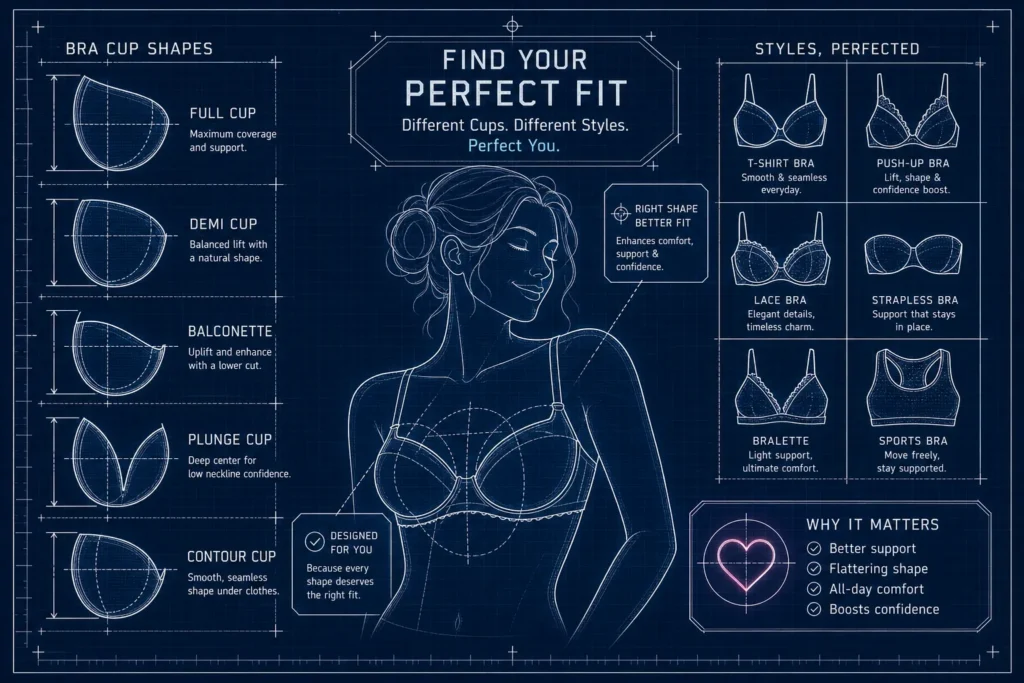
Women’s bra cup shapes: six options explained
Cup shape is the first decision in the development process, not the last. It defines the silhouette, the coverage area, and how the cup interacts with the outer fabric and the body beneath it. Choosing the shape after the pattern is drafted creates problems that no amount of re-sampling will fully resolve.
Round and triangle cups: the everyday workhorses
Round cups produce a symmetrical, projected bust silhouette and are the standard choice for moulded and padded everyday bras. They hold their shape well and work across standard size runs, which makes them the most straightforward option for brands entering a new category. Triangle cups are flatter and wider at the base, with less coverage at the upper cup. They suit bralettes, wire-free designs, and minimal-coverage styles where drape and lightness matter more than structure. Both shapes are commonly stocked by many suppliers, though brands should confirm availability for extended size ranges directly with each supplier before committing to a run.
U-shape, eye-shape and left-right cups for structured designs
U-shape cups follow the natural underbust crease closely, making them a reliable choice for underwired or semi-structured bras where the cup needs to sit flush against the body. Eye-shape cups are narrow and elongated, better suited to push-up or plunge configurations where inward lift is the priority rather than coverage. Left-right cups are anatomically split: the left and right cups are drafted as mirror images rather than identical pieces, which matters for asymmetric or contour designs where fit precision at the centre-front is critical. Using a non-handed cup in a left-right design is a sourcing error that usually only surfaces at the wear-test stage.
Interlock cups: the seamless-friendly women’s bra cup option
Interlock cups use a stretch-knit construction that eliminates hard edges, conforming to the body rather than imposing a fixed shape. This makes them the natural choice for seamless styles, T-shirt bras, and athleisure lines where rigid structure would create visible lines under the shell. Because they flex with the body, they are also used in soft-cup bralettes where controlled projection is not the goal. The trade-off is real: interlock cups provide less defined silhouette than moulded foam, so garments that rely on the cup to carry the shape of the design will need a different option, particularly in styles where the outer shell offers little independent structure.
Matching women’s bra cup materials and thickness to your lingerie line
Shape establishes the silhouette, but material determines how the cup feels, performs under stretch, and holds up through repeated wash cycles. Four core materials cover most lingerie categories: foam, laminated, interlock knit, and polyester. Each behaves differently in production and on the body, and the choice affects everything from sewing ease to consumer returns.
Foam and laminated cups: structure, padding and breathability
Thermo-moulded foam cups offer the cleanest shape retention and are the standard for padded everyday bras. They can be produced in varying densities, with denser foam holding its form longer through wear and washing, while lower-density versions offer a softer hand feel. Laminated cups add a bonded outer layer to foam, giving a smoother surface finish and reducing the risk of delamination over time. They also improve adhesion to outer fabrics, which is particularly important when the shell is lightweight and at risk of strike-through.
Interlock and polyester cups: stretch, softness and performance
Interlock cups move with the body, making them the preferred choice for sportswear, yoga bras, and wire-free styles where stretch and recovery matter as much as shape. Polyester cups sit between foam and stretch knit in terms of rigidity, offering a firmer, more shape-stable alternative to interlock without the bulk of moulded foam. They are commonly used in mid-support sports bras and seamless activewear where some structure is needed without full moulding.
How thickness levels affect the final garment
Cup thickness is measured in millimetres and typically ranges from 3 mm to 12 mm or more. Thin cups in the 2, 4 mm range suit seamless and second-skin styles where bulk is undesirable and visible edges would show through the outer shell; note that thickness may taper at the edges to further reduce bulk. Mid-range cups in the 6, 8 mm range are the standard for everyday padded bras, while thicker cups of 10 mm and above are used in push-up styles where added projection is part of the design function. Mismatching thickness to the garment category is one of the most common sourcing errors and one of the harder ones to diagnose once sampling is underway.
Matching cup shapes and materials to your lingerie line
The right combination of shape and material differs across lingerie categories. Choosing incorrectly affects both the fit of the final garment and the efficiency of your production line, so this decision belongs in the development brief, not the sampling review.
Everyday and casual lingerie: comfort-first combinations
Round or U-shape foam cups in the 6, 8 mm range are the most reliable choice for padded everyday bras. They hold their shape through repeated washing, work across standard size runs, and are straightforward to sew into structured bra construction. Laminated foam is worth specifying when the outer fabric is lightweight, as the bonded surface prevents strike-through and gives the shell a cleaner, more consistent finish across a production run.
Sports and activewear: what the cup needs to handle
Sports bras require cups that flex without losing shape and resist moisture exposure through activity. Interlock and polyester cups outperform foam here because they tolerate stretch, recover well, and do not absorb sweat the way moulded foam does. For high-impact categories, a thicker polyester cup with bonded edges is a commonly recommended design option for reducing movement and maintaining coverage through a full range of motion, verify performance through wear testing for your specific brief. Foam cups are a frequent sourcing shortcut in this category; that substitution typically surfaces as a fit failure at wear testing.
Seamless and T-shirt bras: where material choice is non-negotiable
Seamless styles require cups with no hard edges and minimal bulk, and interlock cups are the natural fit. For T-shirt bras, moulded foam with a fine laminate finish delivers the smooth, seam-free silhouette that the style depends on. In both cases, the cup must be sourced to tight tolerances: shape variation in the cup will show through the outer fabric, and there is no seaming or structure to conceal it.
What to check before you place a bulk order
Quality in bra cups is not always visible at the sample stage. Problems with edge finishing, laminate adhesion, and sizing tolerance often emerge at scale, when small inconsistencies across a batch become visible returns. Brands that skip structured quality checks before bulk authorisation absorb the cost through rework and replacements.
Cup sizing, measurement and spec compliance
Every women’s bra cup should be verified against a written spec sheet that includes dimensions, thickness, shape profile, and material composition. For Indian production, working tolerances for cup width and height are typically ±3 mm (as commonly applied in Indian lingerie manufacturing), with tighter tolerances of ±2 mm for sensitive areas such as the centre-front bridge. Request a tolerance document alongside the physical sample and cross-check both against your pattern grading before signing off on pre-production. It is also worth asking your supplier for a cup size chart that maps cup volume to band size, as this becomes essential when grading across a wide size run or working with sister sizes, where a different band size paired with a different cup size yields the same cup volume.
Quality checks that protect your brand
Key checks include edge finishing consistency with no raw or uneven edges, foam density uniformity across a batch, and laminate adhesion strength confirmed by a standard wash test. Shape retention after compression is also critical: a cup that flattens and does not recover will undermine the garment’s silhouette within weeks of consumer use. Test samples from multiple positions in a batch, not just the first pieces off the line, to catch variation across a production run rather than approving on the basis of one well-made piece.
Sourcing cups at scale: MOQ, lead times and custom options
Understanding how cup sourcing works in practice saves brands from two common mistakes: ordering too small a quantity to get consistent quality, and committing to a supplier before verifying their custom capability. Both mistakes are recoverable, but both cost time and margin.
Planning your first bulk order around MOQ and timelines
MOQs vary by supplier and product complexity, but many manufacturers have thresholds in the hundreds to low thousands of pairs per style and specification, confirm the exact figure with each supplier. Below the minimum, pricing becomes inconsistent and batch quality is harder to control because short runs create more process variation. Lead times are equally supplier-dependent: a common range for standard shapes and materials is four to six weeks, while custom shapes or OEM specifications often extend to eight to twelve weeks. Treat these as starting estimates and confirm current timelines with your chosen vendor before building them into your product development calendar.
OEM/ODM and sample swatches: how to de-risk sourcing decisions
Custom OEM and ODM options allow brands to specify cup shape, material, thickness, and size range for private-label production without being limited to catalogue standards. Before committing to any bulk order, request physical sample swatches across the material and thickness combinations you are considering and verify each against your patterns. SME Bra Cups, based in Delhi, is one supplier offering sample swatches alongside product specifications across foam, laminated, interlock, and polyester materials, confirm current MOQs, available cup shapes, and lead times directly with their team. Working with a supplier who covers the full range of shapes and materials under one roof reduces the supplier-management overhead that comes with sourcing a varied lingerie line.
Start with the cup, not the shell
The core decision framework is straightforward: start with the women’s bra cup shape that suits the silhouette and lingerie category, then select the material and thickness that match the performance requirements. From there, verify specifications through sample swatches and tolerance documentation before committing to bulk. This sequence keeps the design intent intact through production rather than requiring adjustments after patterns are already graded.
The cup choice is a foundational product decision. Brands that get it right early avoid expensive redesign cycles and the production inconsistencies that compound through a range. Those that treat it as a finishing detail end up adjusting patterns against cups rather than selecting cups that support the pattern from the start.
If you are building a new range or expanding an existing one, request sample swatches and a spec sheet from your cup supplier before finalising your patterns. Confirming both together at the development stage is significantly cheaper than correcting the mismatch in bulk. Get in touch with the SME Bra Cups team to request swatches and spec sheets for the cup shapes relevant to your current range.